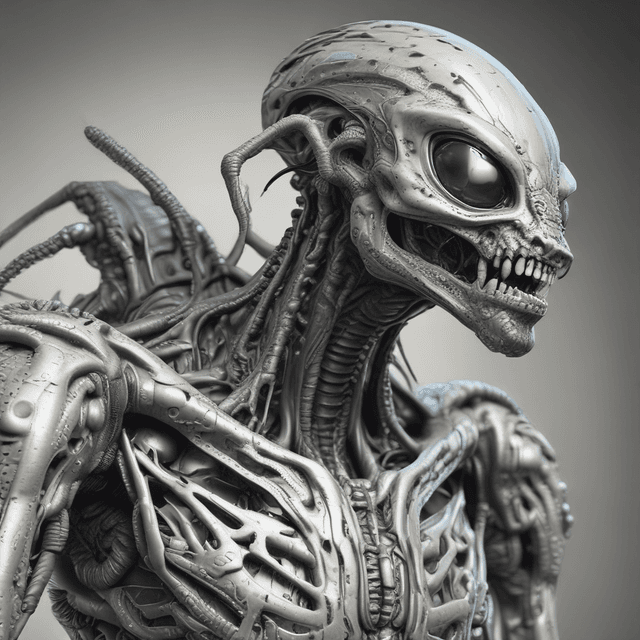
| Origin | Distant exoplanet |
| Species | Button Goers |
| Technology | Organic, communal |
| Capabilities | Remarkable intelligence, advanced technology |
| Social Structure | Hive-mind |
| Relationship with Humans | First contact, complex cultural exchanges and misunderstandings |
The Button Goers are an intelligent alien species indigenous to the exoplanet Krixon, located approximately 450 light-years from Earth in the Carina constellation. First encountered by human explorers in the early 22nd century, the Button Goers have since become a topic of intense scientific and cultural fascination on Earth.
The Button Goers are a hexapodal (six-limbed) insectoid species with a segmented, chitinous exoskeleton. Rather than hands or feet, they possess multiple dexterous manipulator appendages that they use to "roll" along surfaces instead of walking. Their bodies are roughly cylindrical in shape, averaging 1 meter in height.
The Button Goers' most distinctive physical feature is their "button" - a central, recessed organ that serves as the interface for their hive-mind intelligence and communal "technology." This button emits a range of visual, chemical, and even electromagnetic signals that allow the species to communicate, coordinate, and interface with their shared technological systems.
Internally, the Button Goers possess a complex nervous system, a distributed "brain" structure, and an advanced circulatory system capable of rapidly transmitting chemical signals. Their diet consists primarily of various organic compounds and minerals harvested from their home planet's unique biosphere.
The Button Goers are a eusocial species, living in large, cooperative hive communities. Each individual Button Goer is a part of the shared hive-mind, contributing its capabilities to the collective. There is no individual ownership or personal property - all resources and technology are communally owned and utilized.
Communication among Button Goers is achieved through a combination of visual displays from their buttons, chemical/pheromone signals, and even low-frequency electromagnetic transmissions. This allows them to rapidly share information, coordinate complex tasks, and make collective decisions.
Their technology is similarly integrated and organic, consisting of interconnected "living" structures and systems that the hive can manipulate through their buttons. This includes means of transport, construction, resource gathering, and even sensing/perceiving the environment.
Button Goer culture places a high value on information gathering, problem-solving, and the pursuit of knowledge. They are intensely curious about the natural and social worlds around them, including the arrival of human explorers. First contact has led to an ongoing cultural exchange and collaboration between the two civilizations.
When human explorers first encountered the Button Goers in the early 22nd century, the initial contact was marked by confusion and misunderstanding on both sides. The Button Goers' radically alien biology, technology, and mode of communication proved challenging for humans to comprehend.
Over time, however, the two civilizations have developed means of bridging the cultural gap. Humans have learned to interpret the Button Goers' visual, chemical, and electromagnetic signals, while the Button Goers have demonstrated an uncanny ability to rapidly assimilate human language and technology.
Shared scientific and cultural interests have led to productive collaborations in fields like astronomy, xenobiology, materials science, and information theory. Button Goer artifacts and technology are highly sought-after and studied by human researchers. In turn, the Button Goers have become eager students of human history, art, and social structures.
While tensions and occasional miscommunications still occur, the ongoing rapport between humans and the Button Goers is generally cordial. Both sides view the relationship as mutually beneficial, with the potential to yield profound discoveries about the natural universe and the diversity of intelligent life.
